
How Does an Unshaven Hair Transplant Work?
Many people are reluctant to have their entire heads shaved for a hair transplant surgery. However, through an unshaven hair transplant, it’s possible to get this procedure with much more secrecy — at least initially. Still, as good as it may sound, this type of procedure has its pros and cons. Here, we’ll take a closer look at how unshaven hair transplants are performed, as well as their limitations.
What Is An Unshaven Hair Transplant?
Unshaven hair transplantation refers to hair transplant procedures that involve either partial shaving or no shaving of the head for the surgery. Having an unshaven hair transplant has the advantage of being more discreet, especially for people who are in the public eye.
Nevertheless, as with any hair transplant, patients can still experience temporary shedding or “shock loss” after the procedure, which can make their transplanted area look patchy, sparse and unusual for some time. But in the event that one wishes to preview their hair transplant over a short period of time, perhaps for an upcoming wedding, this can be a good option.
However, due to the different shaving methods involved, bear in mind that the term “unshaven” can mean different things.
What Are The Different Types Of Unshaven Hair Transplants?
Let’s take a closer look at the different meanings of an unshaven hair transplant:
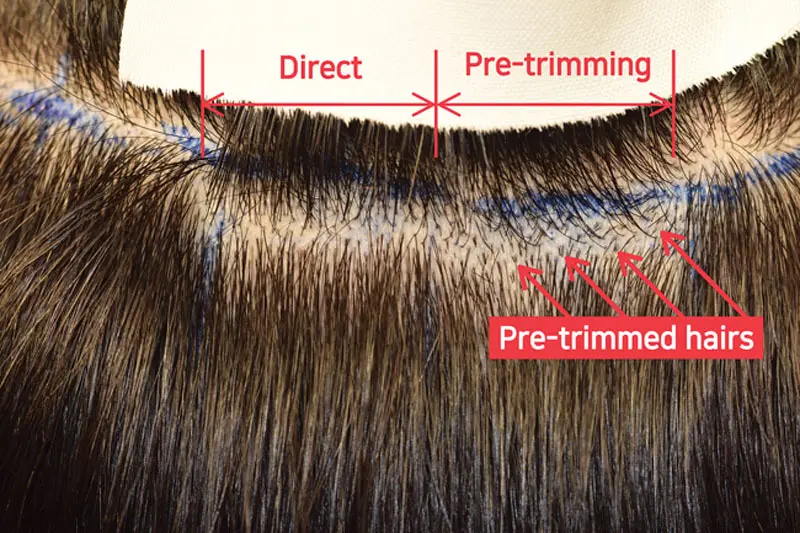
The non-shaven FUE procedure, also known as NS-FUE, is closest to what is considered a truly unshaven procedure, as it doesn’t involve shaving of the donor or recipient areas of the scalp. Although, a certain degree of trimming is involved in a few of its methods.
A non-shaven FUE hair transplant can be done in three different ways, as identified in a 2021 study published in the International Journal of Dermatology, which are as follows:
Pretrimmed method: The follicles to be extracted are first trimmed to about 1 mm and then taken out from the scalp.
Direct method: Instead of cutting the graft beforehand, the punch tool does it while harvesting the graft from the scalp.
Long hair FUE: The donor area is not shaved, and long hair grafts are extracted from the scalp and then transplanted without any trimming involved. It not only helps the surgeon prevent overharvesting of the donor area, but it also hides the recipient area well.
Also noted in this study, another advantage of long hair FUE is that since the curl of the hair is visible, this can be particularly helpful in procedures which require close matching of the curl (e.g. in an eyebrow hair transplant).

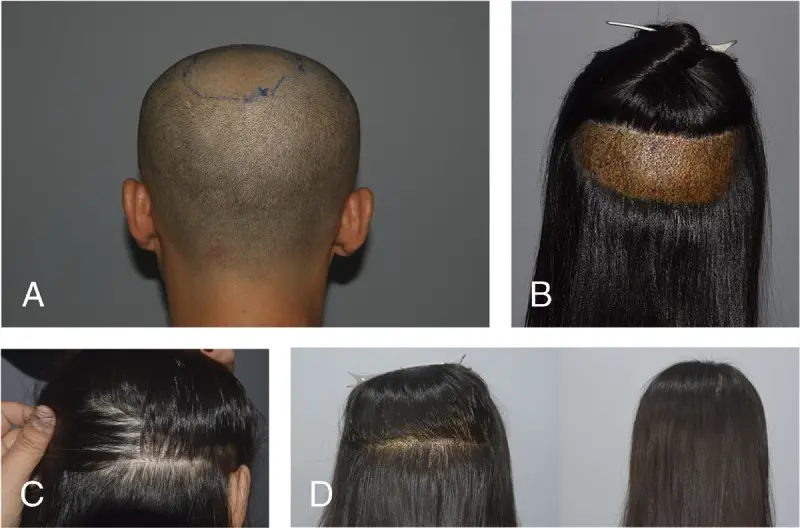
In this type of U-FUE, the donor area is fully shaven, but the recipient area — where the grafts will be implanted — will be left unshaven. This type of hair transplant may use the DHI method for implantation, as it can make graft placement relatively easier.
Follicular unit transplantation (FUT) or strip harvesting surgery can also be done without shaving the donor area. Even if the donor area is shaved, once the strip is excised and the skin is stitched back up, there will essentially be no shaved area left on the scalp, and the stitches will be hidden by the surrounding hair.
However, one of the reasons why FUT has become less popular over time is because it can leave a linear scar on the back of the scalp. And this scar can be quite noticeable when the hair is cut short.
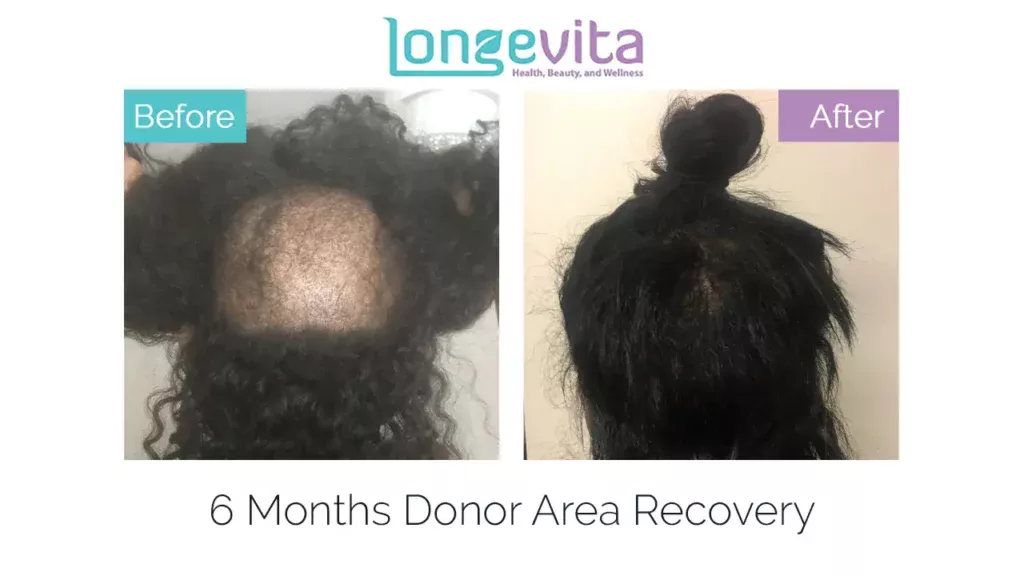
In partial shaving, only a portion of the donor area is shaved — this can be done in one of the two ways:
Window shaving: A small window is shaved at the back of the scalp, which spares the entire donor area from being trimmed. So, if someone has long hair on the sides, this “window” can be covered by it. However, it won’t work for someone with short hair.
Which types of unshaven hair transplants does Longevita offer?
In addition to window shaving FUE, Longevita arranges unshaven DHI hair transplants, in which only the donor area is shaved, and the recipient area is left as is. However, it’s important to keep in mind that not everyone might be considered a suitable candidate for these shaving patterns. That’s because the extent of your hair loss will determine the number of grafts you need and the area of the scalp that needs to be shaved. If you need a large number of grafts, for instance, it won’t be a good idea to extract them all from a small window in your donor area as it will permanently thin out.
Why Is Shaving Common In Traditional FUE?
Ease of extraction and implantation of hair grafts is why the donor and recipient areas are typically shaved in a hair transplant.
Extraction requires correct positioning of the punch tool to reduce the risk of graft transection. The shaving of the donor area makes it easier to see the follicles and avoid this problem as best as possible.
In contrast, with long hair, visibility can be an issue for the surgeon, and there is an increased risk of transection with these types of transplants. The recipient area of the scalp is also shaved to allow the surgeon to place the grafts more easily into the scalp.
What Are The Pros And Cons Of Unshaven Hair Transplant?
Following are some of the pros and cons of unshaven hair transplants:
Makes it possible to have the surgery in a more private manner.
NS-FUE can avoid the overharvestation of the donor area as the surgeon can see the donor area density during extraction.
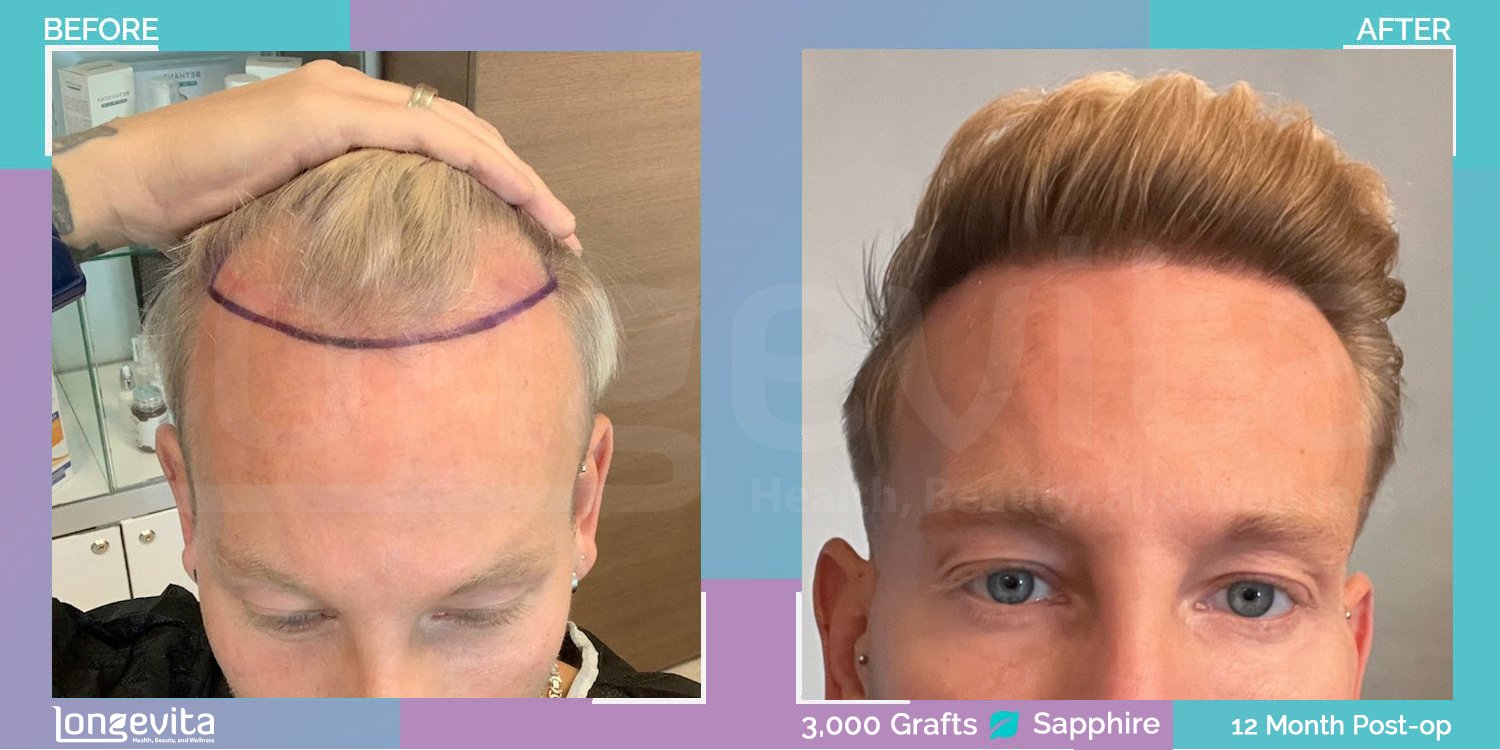
Transplanted grafts with long hair can give patients a preview of what their hair transplant might look like. The surgeon can also immediately see the recipient area density after implantation and make adjustments if needed.
It can cause greater graft transection during extraction.
It can limit the number of grafts that can be extracted, thus making it less suitable for patients with large balding areas.
The surgery is more laborious and time-consuming. A graft harvesting rate of just 157 per hour has been reported with long hair FUE. With a shaved FUE, however, as many as 1,000 grafts can be harvested in one hour.
It is more expensive than a traditional FUE. Also, additional procedures to achieve your desired density will add to the overall cost.
The long hair FUE “preview” is temporary, as you will lose your transplanted hair after 2-3 weeks due to shock loss.
You have to be extremely careful during recovery to not end up dislodging or ripping out a graft from your scalp.
How Much Does An Unshaven Hair Transplant Cost?
The price per graft for an unshaven FUE can vary from £7 to £10 in the UK. You can expect it to be higher than the average £4 per graft for a shaved FUE, as U-FUE requires greater expertise and is more labour-intensive.
However, since there are different types of unshaven hair transplants, some more complicated than others, the price can vary accordingly. For instance, with Longevita, you can get window shaving FUE or unshaven DHI at no extra cost. Our prices in Turkey are generally quite affordable because of the exchange rates and the lower cost of living in the country.
Interested In An Unshaven Hair Transplant?
Since 2012, Longevita has been a trusted facilitator of affordable and high-quality hair transplants. Working with a team of highly qualified professionals, we have a 98% satisfaction rate and offer a lifetime warranty. In case you are interested in learning more about the treatments we arrange, don’t hesitate to get in touch.

Dr Cagla
Dr Cagla earned her medical degree at Trakya University’s Faculty of Medicine in Bulgaria and has almost 6 years of hair transplantation experience. She is a specialist in FUE, DHI and Sapphire hair transplants of the scalp, eyebrows and beard and has performed over 6,000 surgeries. Dr Cagla is multilingual, with fluency in English, Bulgarian and Turkish.