
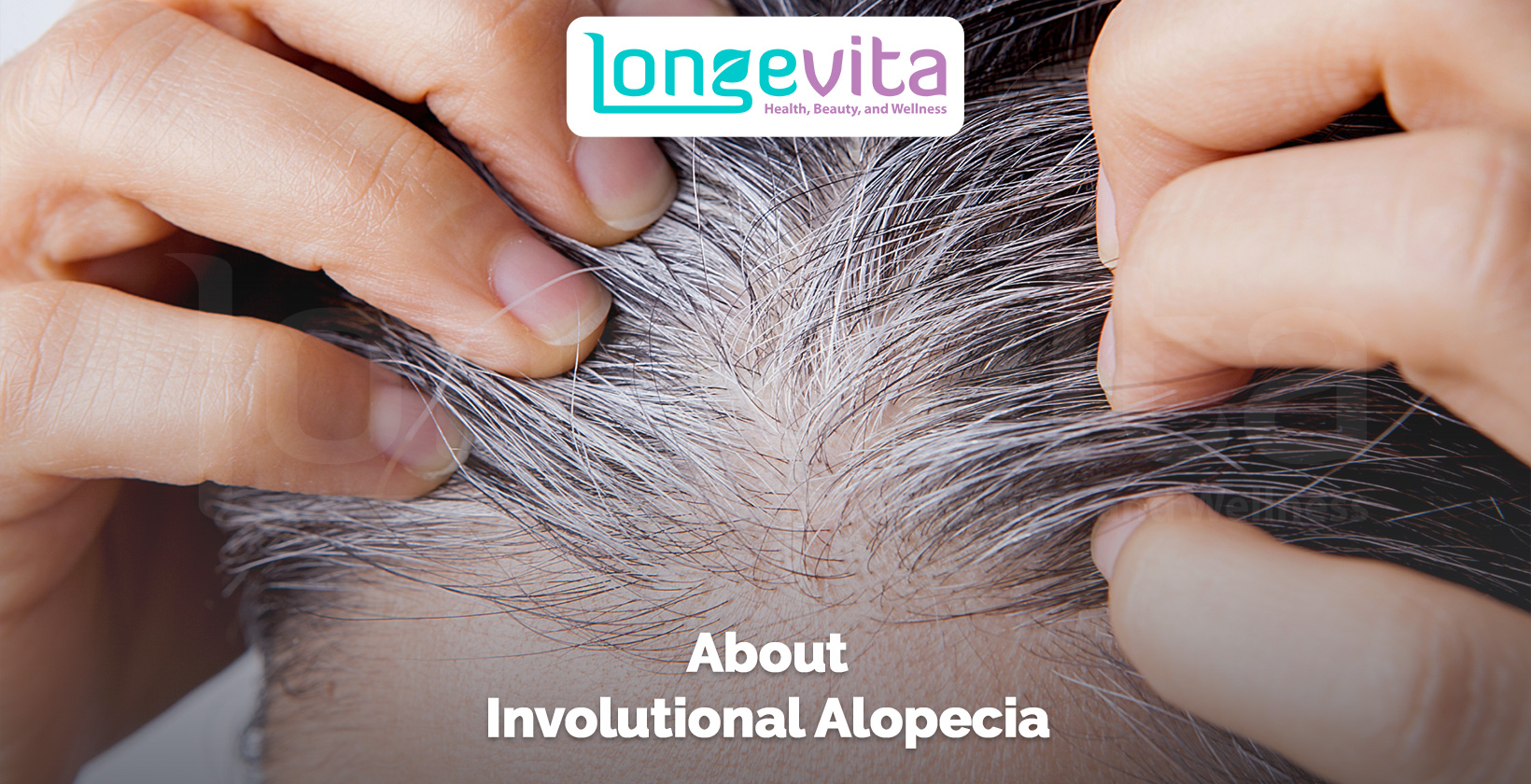
Involutional alopecia refers to the natural thinning of hair with age. Also known as senescent or senile alopecia, it’s accompanied by changes in hair colour, texture, and thickness. In this guide, you will learn more about the causes, reversibility and potential treatments for this type of hair loss.
What Is Involutional Alopecia?
Involution refers to the decline in the normal functioning of a part of the body due to ageing. Therefore, involutional alopecia is one that’s caused by naturally increasing age.
It can occur even if there’s no family history of this condition, and it can affect both men and women.

Bourezane Y, Bourezane I. Proposition of a New Terminology of Senile Alopecia: Physiologic Alopecia. Int J Trichology. 2023 Jan-Feb;15(1):41-42. doi: 10.4103/ijt.ijt_54_21. Epub 2023 Apr 19. PMID: 37305190; PMCID: PMC10251292/CC BY-NC-SA 4.0
In senescent alopecia, what happens is that the hair growth cycle is altered. The anagen (growing) phase is shortened, so hair doesn’t grow too long. Additionally, there’s a bigger gap between the telogen (resting) and anagen phase, so the hair grows more slowly.
This hair loss is commonly mixed up with androgenetic alopecia because of its somewhat similar presentation and frequent co-occurrence. However, unlike androgenetic alopecia, involutional alopecia is not triggered by the presence of androgens (testosterone hair loss).
In the past, there has been some controversy around involutional alopecia being labelled a type of hair loss.
A study published in Clinics in Dermatology concluded that significant hair loss in the elderly is usually caused by androgens. There are only a few cases of patients with “deteriorating diffuse alopecia,” and that’s probably an exception.
However, another research published in the Journal of Dermatological Science disputes this because it found the “gene expression profiles” of androgenetic alopecia are different from those of involutional alopecia.
What Are The Signs Of Involutional Alopecia?
Following are the signs of senescent alopecia:
- Reduced hair diameter (thinner hair shaft)
- Slowed hair growth
- Loss of pigment (greying)
- Reduced hair density
- Reduced terminal hair (thick, long and pigmented) count
It should be noted that involutional alopecia doesn’t have a distinct pattern. It occurs diffusely and gradually.
What Causes Involutional Alopecia?
It is believed that oxidative stress contributes to the ageing of hair, according to research published in the International Journal of Trichology.
As we age, more free radicals are produced, but the counter “defence mechanisms decrease,” and this disparity ends up damaging the cellular structures. This, in turn, results in visible signs of ageing, and for the hair, it can be seen in the form of greying and hair loss, as explained in the above study.
Keep in mind that oxidative stress can be caused by a variety of factors, such as exposure to ultraviolet radiation from the sun, pollution, alcohol consumption, smoking, radiation, and a diet high in fat and/or carbohydrate content, among others.
There is also other research that suggests that hair thinning with age may have to do with our hair follicle stem cells. It has been found that over time, “genetic errors” occur in these stem cells and as a result, they would not “rejuvenate any longer”. As these cells play a significant role in the growth of new hair, issues with them would negatively affect the hair.
At What Age Does Involutional Alopecia Start?
Involutional alopecia usually occurs in those above the age of 50 or 60. However, age-related hair changes can start well before that. For instance, a study published in the British Journal of Dermatology found that the hair diameter of women increases from age 20 to 40 or 45. However, it starts to decrease after that.
Is It Possible To Reverse Involutional Alopecia?
Since involutional alopecia occurs due to the natural process of ageing, it is permanent.
Whether it’s oxidative stress or faulty stem cells, it’s unlikely that you’ll grow new hair fibres. Additionally, the related hair changes are also permanent.
What Is The Treatment For Involutional Alopecia?
For age-related hair thinning and shedding, your doctor might prescribe you minoxidil. While it’s not exactly understood how it works, it’s believed to stimulate hair growth by increasing blood flow to the scalp.
The drug only works for as long as you’re using it. It can cause a few side effects and it doesn’t work for everyone. So, make sure to discuss all its pros and cons with your doctor.
You might also be recommended the use of hair products that contain antioxidants like polyphenols, selenium, and vitamins A, C, and E.
Other than that, treatment can include taking steps to improve your general health and lifestyle (protein-rich foods, less alcohol, no smoking) as that may also affect the quality of your hair. On your end, you should also make sure to be gentle with your hair.
PRP therapy for hair rejuvenation and laser therapy may also be helpful in stimulating hair growth.
If you have, however, experienced significant hair growth, a hair transplant is another option that might be considered.
Are You Losing Your Hair?
Since 2012 Longevita has arranged surgical and non-surgical solutions for hair loss while arranging access to teams of highly skilled professionals. Not only do we arrange quality care, but it’s also available at affordable prices. If you’re interested in learning more about what we arrange, feel free to get in touch!

Dr Cagla
Dr Cagla earned her medical degree at Trakya University’s Faculty of Medicine in Bulgaria and has almost 6 years of hair transplantation experience. She is a specialist in FUE, DHI and Sapphire hair transplants of the scalp, eyebrows and beard and has performed over 6,000 surgeries. Dr Cagla is multilingual, with fluency in English, Bulgarian and Turkish.
