
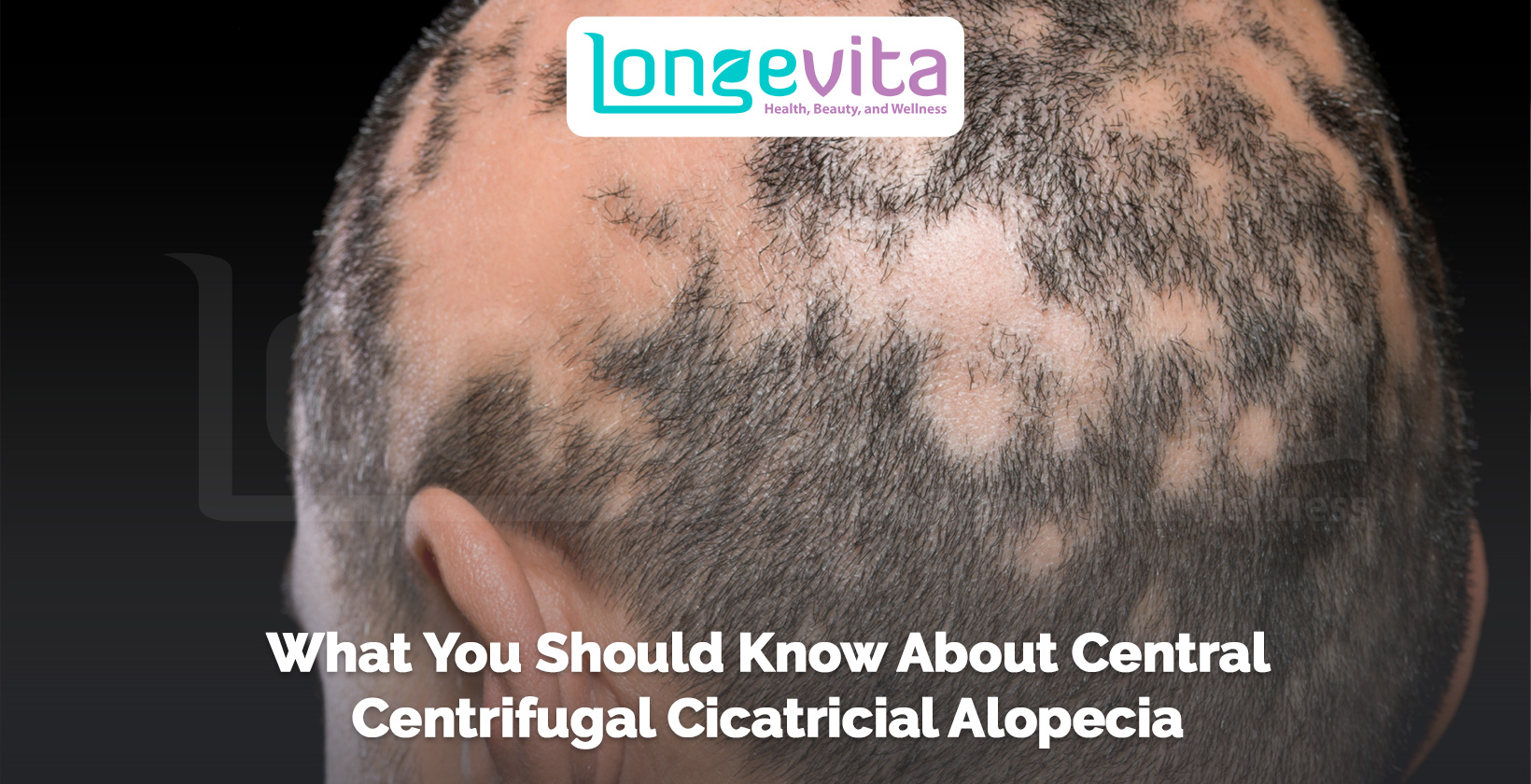
Central centrifugal cicatricial alopecia is the most common type of scarring alopecia that leads to permanent hair loss.
It’s called “central centrifugal” because it affects the centre (crown/vertex) of the scalp and tends to spread in a centrifugal pattern – moving away from the centre. And “cicatricial” just means scarring.
Unfortunately, with this type of hair loss, you may not even realise that you’re losing your hair permanently. The progression can be “silent,” and when it’s finally diagnosed, it might be too late to regrow the hair.
Here, you’ll learn about how central centrifugal cicatricial alopecia progresses, how it may appear and its possible treatments.
What Is Central Centrifugal Cicatricial Alopecia?
Central centrifugal cicatricial alopecia (CCCA) is a type of primary scarring alopecia in which hair follicles are destroyed as a result of inflammation.
It was first described in 1968 as “hot comb alopecia.” The study published in the Archives of Dermatology investigated crown hair loss in 51 African American women who used a hot comb with petrolatum (i.e. petroleum jelly) to straighten their hair. Their hair loss had a centrifugal pattern as well. And according to the researchers, their alopecia was the result of chronic inflammation caused by improper hair care practices, which destroyed their hair follicles.
In 1992, the same condition was investigated in 10 African American women who were also experiencing similar hair loss. The condition was then called “follicular degeneration syndrome,” and chemical relaxers, dyes and tight hairstyles were blamed.
For a while, CCCA was mainly attributed to these. However, further research showed that this wasn’t always the case. Nevertheless, this condition more commonly affects women of African descent — between the ages of 30 and 55.
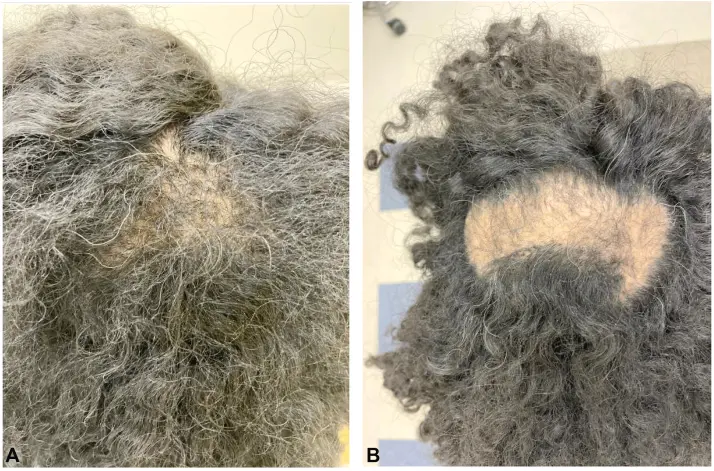
Ogbuefi N, Erickson T, Mhlaba JM. A case of rapid progression of central centrifugal cicatricial alopecia after COVID-19 infection. JAAD Case Rep. 2022 Nov;29:89-91. doi: 10.1016/j.jdcr.2022.08.039. Epub 2022 Sep 9. PMID: 36101703; PMCID: PMC9458759/CC BY-NC-ND 4.0
What Are The Stages Of CCCA?
As reported in a 2016 study, central centrifugal cicatricial alopecia progresses in two stages:
- Early-stage disease: Thinning occurs in the central area of the scalp.
- Late-stage disease: Hair follicles are lost, and the skin of the scalp appears shiny and smooth.
Once the hair follicle has been replaced by scar tissue, you cannot grow your hair back, but if the condition is still in its early stages, getting timely treatment can help hair grow back and stop CCCA from progressing further, according to another research.
How rare is central centrifugal cicatricial alopecia?
Central centrifugal cicatricial alopecia is a rather rare type of hair loss, with prevalence rate ranging from 2-7%, as reported in StatPearls.
What Are The Signs & Symptoms Of CCCA?
Hair breakage and thinning are usually among the early signs of central centrifugal cicatricial alopecia. Usually, it begins at the crown region of the scalp, spreading outward. Eventually, it can end up extending to most of the scalp.
Other signs and symptoms of CCCA include:
- Sore or tender scalp
- Burning sensation
- Itchiness
- Flakiness
- Redness
- Small bumps
- Brittle hair
- Soft/spongy scalp
- Smooth & shiny scalp (when hair follicles are lost)
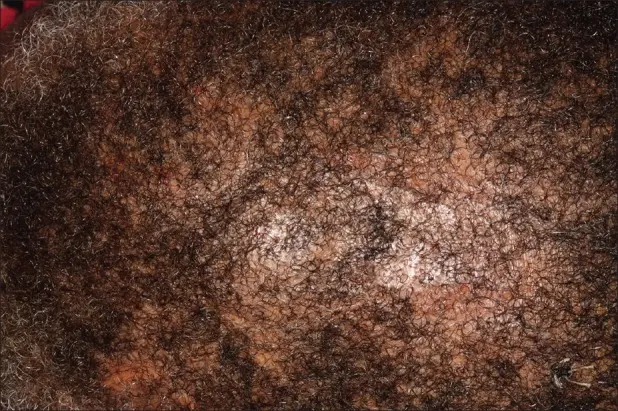
Blattner C, Polley DC, Ferritto F, Elston DM. Central centrifugal cicatricial alopecia. Indian Dermatol Online J. 2013 Jan;4(1):50-1. doi: 10.4103/2229-5178.105484. PMID: 23440368; PMCID: PMC3573455/CC BY-NC-SA 3.0
It’s also possible for central centrifugal cicatricial alopecia to have no symptoms (other than hair loss). Usually, a biopsy is done for an accurate diagnosis.
While central centrifugal cicatricial alopecia usually progresses gradually, it can also happen very rapidly. Keep in mind that this condition is chronic, so it can come and go.
What Causes Central Centrifugal Cicatricial Alopecia?
The exact cause of central centrifugal cicatricial alopecia isn’t known, but genetic and environmental factors have been implicated.
CCCA tends to run in families. And a study published in The New England Journal of Medicine found mutations in a PADI3 gene to be associated with this type of scarring alopecia. And it should be noted that this gene is important for the normal development of the hair shaft.
Other than genetics, however, the use of heat styling tools, tight hairstyles, and chemical relaxers – more common in African women – have also been held responsible for central centrifugal cicatricial alopecia.
Additionally, research has also found associations between CCCA and:
- Bacterial infections
- Fungal infections
- Seborrheic dermatitis
- Autoimmune disease
- Type 2 diabetes
Therefore, it can’t be said for sure that a particular thing causes CCCA; a variety of factors might be involved.
Can Central Centrifugal Cicatricial Alopecia Be Reversed?
Central centrifugal cicatricial alopecia will permanently destroy the hair follicles, so it cannot be reversed. In this condition, the hair follicles are replaced by scar tissue, so regrowth is not possible.
For this reason, early diagnosis and treatment are considered very important. Not only can it prevent further hair loss, but it might also help with hair regrowth (if the follicle isn’t destroyed already).
The more you delay treatment, the worse the results are going to be. But if caught early on, the hair loss can be limited to a smaller area.
What Are The Treatments For Central Centrifugal Cicatricial Alopecia?
Central centrifugal cicatricial alopecia is usually treated with topical and intralesional (injection) corticosteroids. These are anti-inflammatory, so they can help stop the follicular damage by the inflammatory cells.
But steroids aren’t the only treatment option. Among others, the following have also been used:
- Tetracyclines – class of antibiotics with anti-inflammatory properties
- Mycophenolate mofetil – an immunosuppressant with anti-inflammatory effects
- Cyclosporine – also an immunosuppressant with anti-inflammatory effects
- Hydroxychloroquine – an anti-rheumatic drug with anti-inflammatory effects
- Thalidomide – an immunomodulatory agent with anti-inflammatory properties
Minoxidil and platelet-rich plasma therapies have also been used to promote hair regrowth in central centrifugal cicatricial alopecia.
Your doctor will also advise you to change your hair styling and grooming practices. You need to avoid extensions and wearing your hair too tightly. Other than being a potential risk factor for CCCA, such hairstyles can also cause traction alopecia.
Furthermore, you shouldn’t use heat-styling tools like straighteners, curling irons, or blow dryers too much or consider not using them at all. Also, be cautious about chemical relaxers since the “caustic chemicals” in them can result in scarring on the scalp, according to one study.
It’s also important to reduce the frequency of shampooing. You may be advised to cut it down to just once a week. And if you have flaking, your doctor might recommend the use of anti-dandruff shampoo.
How can you stop CCCA from spreading?
In order to stop the outward spread of central centrifugal cicatricial alopecia, it’s important that you seek proper treatment, which can involve medication and changes to your hairstyle practices.
If that’s the case, you can instead consider scalp reduction surgery in which the scalp skin is cut out. Or you can hide the bald spots with wigs or hair fibres.
In any case, it’s important to discuss your treatment options with a qualified and experienced medical professional.
Interested In A Hair Transplant?
Longevita is an award-winning provider of hair transplants in London and Istanbul. We have a 98% success rate, offer patients with the best price guarantee for their treatment with us. If you’re ready to start your journey with us, feel free to contact our expert Patient Consultants. We’re more than happy to help!
Can You Get A Hair Transplant For Central Centrifugal Cicatricial Alopecia?
CCCA patients can get a hair transplant if the inflammation has been under control for at least 1 year. However, it’s important to know that the results might be poor as the hair grafts are less likely to survive.
For central centrifugal cicatricial alopecia patients, there’s also a higher risk of scarring, which can lead to further dissatisfaction with the overall results.
Keep in mind that it’s not always possible to have a hair transplant for this type of alopecia. If the hair loss is too extensive, you won’t have enough donor hair for the surgery to take place.
Frequently Asked Questions
Central centrifugal cicatricial alopecia (CCCA) is a type of primary scarring alopecia that results in permanent loss of hair.
The main difference between cicatricial and non-cicatricial alopecia is that the former causes scarring and is permanent. But in non-scarring alopecia, the hair follicle is intact, so hair loss can be reversed. They can, however, coexist at the same time.
CCCA is a chronic condition and cannot be cured. However, its symptoms can be managed with different treatments.
It may be possible for you to grow some of your hair back after losing it due to CCCA, but it’s important to seek treatment. Once a hair follicle is destroyed, however, the damage is permanent.
When it comes to cicatricial alopecias, progression can take years, or it can happen rapidly over months. But it can vary between people.
Though research has reported an association between autoimmune disease and central centrifugal alopecia, it cannot be said that CCCA is an autoimmune disease. The cause as well as the mechanism of this condition are not yet known.
It may be possible for you to grow some of your hair back after losing it due to CCCA, but it’s important to seek treatment. Once a hair follicle is destroyed, however, the damage is permanent.

Dr Cagla
Dr Cagla earned her medical degree at Trakya University’s Faculty of Medicine in Bulgaria and has almost 6 years of hair transplantation experience. She is a specialist in FUE, DHI and Sapphire hair transplants of the scalp, eyebrows and beard and has performed over 6,000 surgeries. Dr Cagla is multilingual, with fluency in English, Bulgarian and Turkish.
